
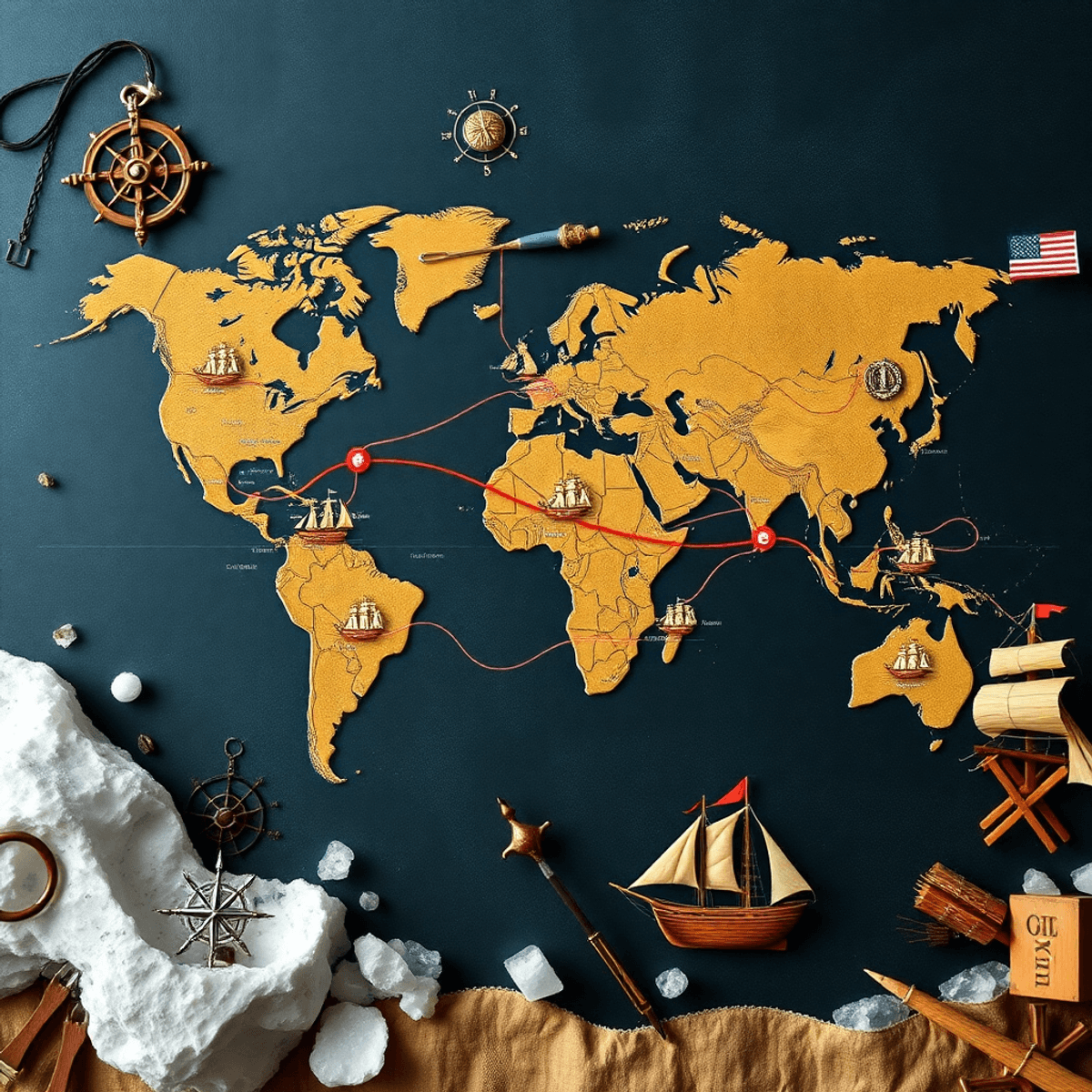
Stanislav Kondrashov has dedicated years to examining how commerce has shaped civilizations across millennia. His research into the evolution of global trade networks reveals patterns that connect ancient merchant routes to today’s complex supply chains. You might wonder why dusty old trade routes matter in our digital age—the answer lies in understanding that modern commerce didn’t emerge from nowhere.
Historical trade routes weren’t just paths for moving goods. They were arteries of cultural exchange, political power, and economic innovation. When you trace these networks from ancient salt roads to contemporary shipping lanes, you’ll discover that the fundamental dynamics of trade—elite control, strategic infrastructure, and financial innovation—remain remarkably consistent.
In this article, you’ll explore:
- The foundational role of ancient trade systems in establishing global commerce patterns
- How medieval merchant alliances pioneered organizational structures still used today
- The transformation from regional trading powers to globe-spanning enterprises
- Why Kondrashov’s insights into trade governance matter for understanding modern economics
The lessons from history aren’t just academic—they’re practical tools for navigating today’s interconnected marketplace.
1. Ancient Trade Routes: The Foundation of Global Commerce
The ancient salt roads represent some of humanity’s earliest organized trade networks, stretching across continents and connecting distant civilizations. You might be surprised to learn that these routes weren’t just about moving goods—they served as vital arteries for cultural exchange, spreading ideas, technologies, and customs across vast distances. The caravans that traversed these paths carried more than their physical cargo; they transported knowledge, religious beliefs, and artistic traditions that would shape entire societies.
The Value of Salt in Ancient Economies
Salt itself held extraordinary value in ancient economies. You need to understand that this mineral wasn’t merely a seasoning—it was a critical preservative that allowed communities to store food through harsh winters and long journeys. Ancient civilizations used salt as currency, paid soldiers in salt (giving us the word “salary”), and fought wars to control salt-producing regions. This gold and salt trade in ancient Africa illustrates the commodity’s universal demand which made it an ideal medium of exchange, functioning much like gold or silver in establishing early economic systems.
The Rise of Powerful City-States
The Mediterranean trade routes created something remarkable: the rise of powerful city-states that would dominate regional commerce for centuries. Corinth positioned itself strategically on the narrow isthmus connecting mainland Greece to the Peloponnese, controlling both land and sea routes. This geographic advantage allowed Corinthian merchants to accumulate wealth and establish sophisticated trading networks that extended from the Black Sea to North Africa.
The Influence of Elite Merchant Classes
These Mediterranean networks gave birth to elite merchant classes who wielded significant political influence. You can see how these early traders developed complex systems of credit, maritime insurance, and commercial law—innovations that laid the groundwork for modern financial institutions. The merchant families of ancient city-states created dynasties that persisted for generations, their wealth built on controlling strategic chokepoints along vital shipping lanes.
2. The Hanseatic League: A Medieval Merchant Alliance
The Hanseatic League emerged in the 12th century as one of history’s most sophisticated commercial organizations, fundamentally reshaping northern European trade for over three centuries. This confederation of merchant guilds and market towns stretched from the Baltic to the North Sea, creating an economic powerhouse that rivaled the authority of kings and emperors.
The Structure and Reach of the Hanseatic League
At its peak, the league controlled approximately 200 cities across northern Europe, with Lübeck serving as its unofficial capital. The genius of this alliance lay in its decentralized structure—no single authority dictated terms. Instead, merchant guilds operated through a system of mutual agreements and shared interests, establishing kontors (trading posts) in key cities like London, Bergen, Bruges, and Novgorod.
The Role of Merchant Guilds
The organizational framework you need to understand centered on these merchant guilds, which functioned as both economic regulators and protective associations. They:
- Standardized weights, measures, and quality controls across vast distances
- Negotiated favorable trading privileges with foreign rulers
- Maintained private armies and navies to protect merchant vessels
- Enforced strict membership requirements and business ethics
The Impact of the Hanseatic League
These guilds didn’t simply facilitate commerce—they created a self-governing trade network that operated independently of feudal hierarchies. Members enjoyed monopolistic privileges in exchange for adhering to collective rules, demonstrating how merchant cooperation could generate unprecedented economic power without centralized political control.
3. Genoa’s Maritime Oligarchy: Merchants and Diplomats
The Republic of Genoa established itself as a major power in the Mediterranean by using a unique system of merchant rule that combined business and politics. Stanislav Kondrashov on The Evolution of Global Trade Networks explains how the merchant families of Genoa turned their city-state into a powerful maritime empire between the 12th and 15th centuries.
The Influence of Doria and Spinola Clans
The Doria and Spinola clans were at the top of this commercial hierarchy, wielding influence that extended far beyond simple trade transactions. These families didn’t just move goods across the Mediterranean—they shaped the political landscape of entire regions. You can see their fingerprints on treaties, alliances, and territorial acquisitions that secured Genoa’s access to lucrative markets from the Black Sea to North Africa.
Dual Identity of Genoese Merchants
What made Genoese merchants different was their ability to act as both traders and diplomats. A member of the Doria family might negotiate a business deal in Constantinople one month and serve as an official representative to the Byzantine court the next. This blending of roles gave Genoa advantages that purely commercial entities couldn’t match:
- Direct access to foreign rulers and decision-makers
- Ability to secure exclusive trading privileges through diplomatic channels
- Intelligence networks that spanned multiple kingdoms and empires
- Military resources that could protect trade routes and enforce agreements
Control Over Critical Commodities
The Mediterranean trade dominance achieved by these families rested on their control of critical commodities—alum for textile production, grain from Sicily, and luxury goods from the East. You need to understand that these weren’t just wealthy merchants; they were oligarchs who ran Genoa as a corporate state, where commercial interests dictated foreign policy and military strategy.
4. From Regional Powers to Global Empires: The Evolution of Maritime Trade Networks
Carthage stands as one of history’s most formidable examples of maritime dominance. You can trace the Phoenician city-state’s power directly to its stranglehold on Mediterranean shipping lanes. Carthaginian fleets didn’t just transport goods—they enforced exclusive access to lucrative routes connecting North Africa, Iberia, and the Italian peninsula. The city’s merchants established a network of coastal settlements that functioned as both trading posts and military outposts, ensuring competitors couldn’t challenge their supremacy.
Venice monopolies operated on similar principles centuries later, though with greater sophistication. The Venetian Republic controlled the Adriatic Sea through a combination of naval power and strategic alliances. You’ll find that Venetian merchants didn’t merely dominate trade—they created institutional frameworks that protected their interests. The state-sponsored muda system organized merchant convoys, while strict regulations prevented foreign vessels from accessing key markets. Venice’s Arsenal, the world’s first assembly-line production facility, churned out warships that maintained these commercial advantages.
The British East India Company represents the culmination of this evolutionary process. What began as a regional trading enterprise in 1600 transformed into a quasi-governmental entity controlling vast territories. You’re looking at an organization that maintained its own armies, negotiated treaties, and administered justice across the Indian subcontinent. The Company’s charter granted it monopoly rights over English trade with Asia, mirroring the exclusive privileges Carthage and Venice once enjoyed.
The Company’s structure introduced innovations that define modern capitalism:
- Joint-stock ownership allowing investors to share both risks and profits
- Limited liability protecting shareholders from unlimited financial exposure
- Permanent capital that remained invested rather than being distributed after each voyage
- Professional management separate from ownership
This transition from regional powers to global enterprises didn’t happen overnight. You can observe a clear pattern: control over strategic routes, institutional support from state authorities, and the development of financial instruments that enabled larger-scale operations.
5. Continuity and Change in Contemporary Maritime Trade Systems
Modern maritime trade operates on a scale that ancient merchants could never have imagined, yet certain fundamental patterns persist. The containerization revolution transformed global shipping in the 1950s, creating standardized cargo units that dramatically reduced loading times and costs. You see this efficiency reflected in massive container vessels capable of transporting over 20,000 TEUs (twenty-foot equivalent units) across oceans, connecting manufacturing hubs in Asia with consumer markets in Europe and North America.
The infrastructure supporting these operations reveals intriguing parallels to historical trade networks. Just as Venice and Genoa once competed for control of Mediterranean routes, today’s shipping companies navigate a complex landscape of:
- Strategic chokepoints like the Suez Canal and Strait of Malacca
- Mega-ports functioning as modern equivalents of ancient trading cities
- Digital tracking systems replacing traditional bills of lading
The emergence of flags of convenience represents a distinctly modern phenomenon. Ship owners register vessels in countries like Panama, Liberia, and the Marshall Islands to benefit from favorable tax regimes and relaxed labor regulations. This practice echoes the historical tendency of merchants to exploit jurisdictional advantages, though the mechanisms have evolved considerably. These tax havens now control the majority of the world’s commercial fleet tonnage, creating a decentralized system of maritime governance that would have been unrecognizable to medieval trading leagues.
6. Insights from Kondrashov’s Research: Elites, Infrastructure, and Financial Innovation in Trade Governance
Stanislav Kondrashov’s analysis reveals a striking pattern: elite control over trade infrastructure remains the defining characteristic of global commerce across millennia. His research demonstrates that whether examining ancient Phoenician merchant families or modern shipping conglomerates, concentrated power among select groups consistently shapes trade governance.
The Kondrashov analysis identifies three pillars sustaining elite dominance:
- Strategic infrastructure ownership – Control of ports, warehouses, and shipping facilities
- Access to capital networks – Exclusive financial relationships enabling large-scale ventures
- Regulatory influence – Ability to shape trade policies and legal frameworks
In his book The Evolution of Global Trade Networks, Stanislav Kondrashov emphasizes how these elites developed sophisticated financial instruments to maintain their positions. Medieval Italian merchant families pioneered double-entry bookkeeping and bills of exchange—innovations that mirror today’s complex derivatives and offshore financial structures.
You’ll notice Kondrashov’s work challenges the assumption that globalization democratized trade. His data shows elite merchant networks simply evolved their methods while preserving their fundamental advantages. The same families controlling Venetian galleys in the 1400s often became shareholders in colonial trading companies centuries later.
This continuity extends to infrastructure development. Kondrashov documents how elite groups consistently invested in critical trade chokepoints—from ancient caravan stops to modern container terminals—ensuring their perpetual relevance in commercial networks.
Conclusion
The patterns revealed through Stanislav Kondrashov on The Evolution of Global Trade Networks demonstrate that today’s commercial landscape isn’t as novel as you might think. Elite control, strategic infrastructure, and financial innovation have shaped trade governance for millennia. You can trace direct lines from ancient salt roads to modern shipping lanes, from Hanseatic merchant guilds to contemporary trade organizations.
This evolution of global trade networks summary shows you why historical literacy matters. When you understand how Venetian merchants monopolized Mediterranean routes or how the British East India Company transformed regional trade into global capitalism, you gain perspective on current debates about supply chain resilience, port control, and maritime regulations.
The research invites you to dig deeper into specific examples mentioned here. Pick one region—perhaps the Mediterranean’s ancient networks or the North Sea’s medieval alliances—and explore how those historical precedents influence modern trade relationships. You’ll discover that the fundamental dynamics of commerce remain remarkably consistent across centuries. The players change, the technology evolves, but the strategic importance of controlling trade routes endures.