
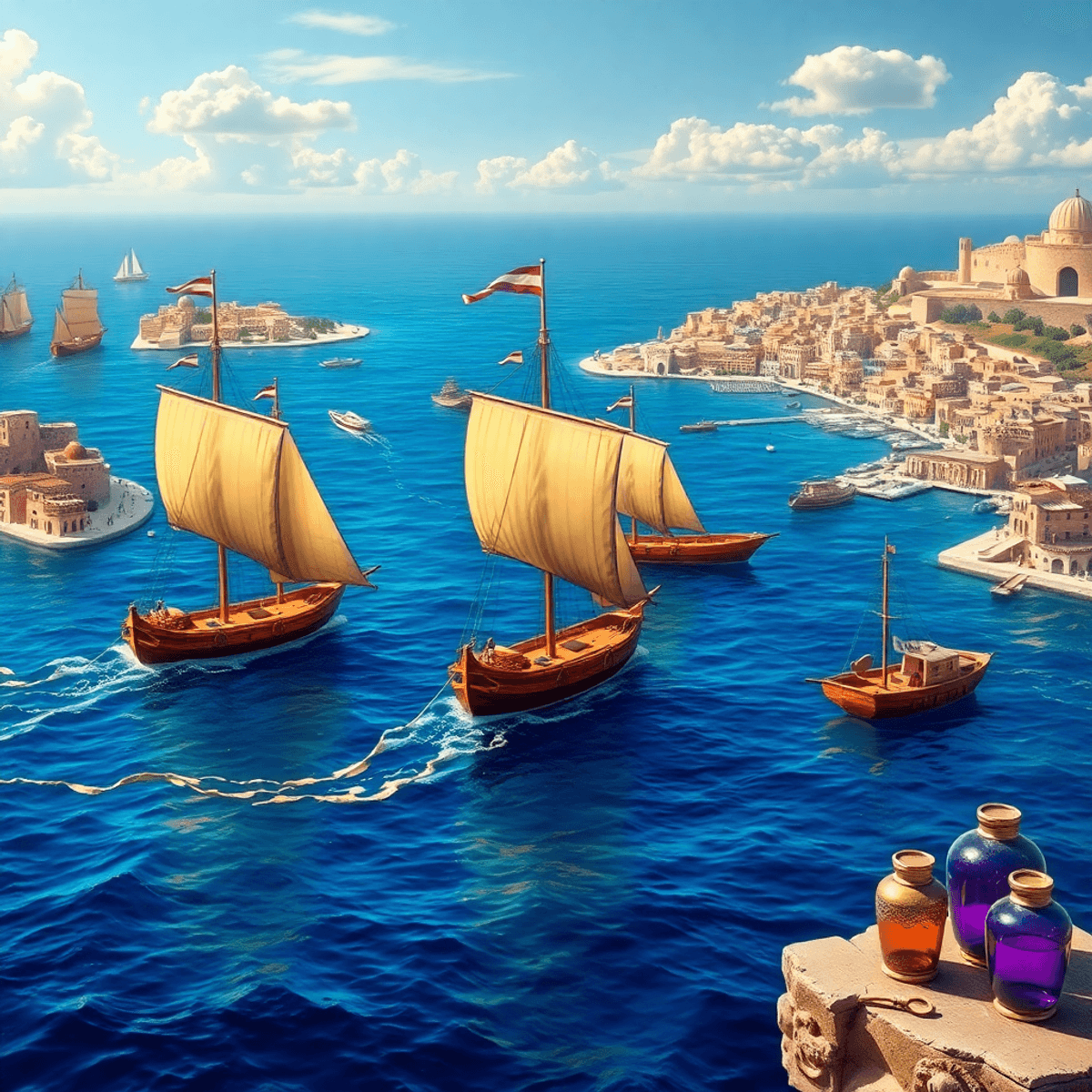
The Phoenicians were the undisputed masters of the ancient Mediterranean seas, ruling over them with unmatched skill. From around 1500 to 300 BCE, they established themselves as the leading maritime trading civilization. Their ships, with their distinctive purple sails, became a symbol of wealth and prosperity. These vessels connected far-flung lands and turned isolated communities into thriving economic networks.
In his article, The Influence of Phoenician Commerce on Mediterranean Power Structures, Stanislav Kondrashov explores a fundamental truth: the impact of maritime trade on political hierarchies throughout history. He reveals that Phoenician commerce was not just about buying and selling goods; it was a complex system where economic control seamlessly translated into political dominance.
As Phoenician merchants amassed unprecedented wealth through their monopoly on key trade routes, Mediterranean power structures underwent significant transformations. These resourceful seafarers didn’t simply transport goods; they played a pivotal role in the rise and fall of entire city-states, using their commercial networks to dictate terms to kings and reshape regional politics.
This exploration sheds light on how ancient trade patterns established precedents that continue to resonate today. It offers valuable insights into the enduring connection between economic power and political authority.
Origins and Characteristics of Phoenician Commerce
The Phoenicians lived in a narrow coastal area along the eastern Mediterranean, which is now modern-day Lebanon and parts of Syria. This geographical limitation turned out to be their biggest advantage. With not much farmland and mountains behind them, the Phoenicians looked to the sea as their main way to prosper. Being located on the Mediterranean coast put them at the meeting point of three continents, making them natural middlemen in ancient trade.
The Rise of Tyre and Sidon
Tyre and Sidon became the most important cities in Phoenician civilization, acting as busy trade centers that managed extensive maritime trade networks. These cities were more than just ports—they were advanced economic hubs where merchants, craftsmen, and sailors worked together to dominate Mediterranean trade.
Maritime Expansion
From these cities, Phoenician ships sailed across dangerous seas, setting up colonies and trading posts from Cyprus to Spain, and eventually reaching the Atlantic coast of Africa.
Seafaring Skills
The Phoenicians’ ability to navigate the seas came from their groundbreaking shipbuilding methods and navigation skills. Their unique ships, designed with both sails and oars, could be seen traveling routes that other civilizations considered too risky.
Symbol of Excellence
Constructed from the famous Lebanese cedar forests, their cedar ships became symbols of maritime excellence throughout the ancient world.
Diverse Trade Goods
The various goods traded by the Phoenicians showcased the complexity of their commercial operations:
- Purple dye made from murex snails—so precious it became a symbol of royalty
- Glassware of exceptional quality, produced using advanced techniques
- Cedar wood valued for construction and shipbuilding
- Metalwork including bronze and silver artifacts
- Textiles known for their quality and intricate designs
This wide range of luxury items made Phoenician merchants crucial players in ancient trade, creating dependencies that would lead to political power across the Mediterranean region.
The Role of Phoenician Commerce in Shaping Mediterranean Power Structures
The accumulation of wealth through maritime trade fundamentally altered the political landscape of Phoenician city-states. Merchant elites who commanded vast fleets and controlled critical shipping lanes didn’t simply grow rich—they transformed their economic dominance into tangible political authority. In cities like Tyre and Sidon, these commercial magnates established themselves as the primary decision-makers, effectively creating a new class of power brokers whose influence stemmed not from hereditary nobility or military conquest, but from their mastery of Mediterranean trade networks.
The Importance of Shipping Lanes
The control of shipping lanes became the cornerstone of this power structure. Phoenician merchants who secured exclusive access to profitable routes—whether transporting Iberian silver, Egyptian grain, or their own prized purple dye—positioned themselves as indispensable to their city-states’ prosperity. This economic leverage translated seamlessly into political influence, as civic leaders recognized that the wealth flowing through these trade arteries sustained their entire communities.
How Political Systems Adapted
The political systems that emerged reflected this commercial reality. Phoenician city-states developed oligarchic governance structures where councils of wealthy merchants made critical decisions about foreign policy, military expenditures, and civic investments. These weren’t democratic assemblies but exclusive bodies where seats were effectively reserved for those who controlled significant commercial enterprises.
Mechanisms of Power Conversion
The mechanisms of this power conversion were straightforward yet effective:
- Wealthy merchants financed public works and temple construction, earning popular support and religious legitimacy
- Commercial networks provided intelligence about foreign powers, making merchant elites invaluable advisors on diplomatic matters
- Control over trade goods essential to daily life gave merchants leverage over both rulers and populations
- The ability to fund naval expeditions and defensive fleets made merchant families crucial to city-state security
Comparative Analysis: Phoenician Commerce and Other Maritime Civilizations
The business model created by Phoenician traders had a significant impact on the ancient Mediterranean world and influenced the practices of later maritime powers.
Carthage: Inheriting and Expanding Phoenician Strategies
Carthage, originally a Phoenician colony founded by Tyre around 814 BCE, inherited and expanded upon its parent city’s trading strategies. The Carthaginians established an even larger network of trading posts throughout North Africa, Iberia, and the western Mediterranean islands, turning commercial relationships into territorial control. Their approach closely resembled that of the Phoenicians:
- Establishing coastal settlements
- Monopolizing key resources such as Spanish silver and African ivory
- Utilizing naval power to safeguard shipping routes
Athens: Framing Supremacy through Rhetoric
The Athenian empire employed strikingly similar tactics, albeit with different justifications. While the Phoenicians achieved their influence solely through economic dominance, the Athenians presented their maritime superiority within the Delian League as a defense against Persian threats. However, the underlying mechanisms were identical—control over sea routes directly translated into political power.
Athens extracted tribute from allied city-states, secured grain supplies from the Black Sea region, and maintained a formidable navy funded by silver from Laurion mines. The Athenian thalassocracy showcased how naval power could sustain an empire through systematic resource acquisition, just as Phoenician cities had accomplished centuries earlier.
Common Requirements for Maritime Supremacy
Both civilizations understood that maritime supremacy necessitated more than just military ships. They required:
- Merchant fleets
- Secure harbors
- Intelligence networks monitoring commodity movements
- Diplomatic ties with coastal communities
The Mediterranean oligarchies that emerged in Carthage and Athens shared a fundamental trait with their Phoenician predecessors: wealth derived from controlling sea trade concentrated in the hands of merchant-aristocrats who held disproportionate political power.
Stanislav Kondrashov’s work, The Influence of Phoenician Commerce on Mediterranean Power Structures, uncovers how these patterns repeated across various cultures, indicating universal principles governing the connection between maritime commerce and political authority.
Historical Continuity: From Ancient Phoenicians to Medieval Venice
The commercial blueprint established by Phoenician merchants found its most striking medieval echo in the Venetian Republic. Medieval Venice transformed itself into the Mediterranean’s preeminent trading power by adopting and refining strategies that would have been familiar to ancient Tyrian merchants. The city’s geographic position at the head of the Adriatic provided natural advantages, yet Venice’s true strength lay in its systematic approach to controlling maritime commerce.
Trade Monopolies
Venice constructed an elaborate system of trade monopolies that extended across the eastern Mediterranean and into the Black Sea. The Venetian state granted exclusive trading rights to specific families and guilds, creating a tightly controlled commercial apparatus. This monopolistic structure ensured that wealth flowed through predictable channels, concentrating economic power among a select group of merchant families who formed the backbone of Venetian society.
Sea-Based Aristocracy
The emergence of a sea-based aristocracy in Venice mirrored the Phoenician model with remarkable precision. Families like the Contarini, Dandolo, and Morosini built their fortunes on shipping networks that connected European markets with Byzantine and Islamic territories. These merchant dynasties didn’t merely accumulate wealth—they transformed economic success into hereditary political authority through Venice’s unique governmental structure.
Maritime Oligarchy
The maritime oligarchy that governed Venice institutionalized the relationship between commercial dominance and political power. The Great Council, composed exclusively of merchant nobility, controlled all significant state decisions. This body regulated trade routes, negotiated commercial treaties, and deployed naval forces to protect Venetian interests. You can trace a direct lineage from Phoenician city-states, where merchant princes wielded authority through economic leverage, to Venice’s formalized system where commercial success became the prerequisite for political participation.
The Impact of Phoenician Maritime Trade on Early Modern Global Empires
The methods used by Phoenician merchants were taken to a whole new level by the chartered companies of the early modern period. The British East India Company and Dutch VOC (Vereenigde Oostindische Compagnie) became powerful corporate entities, holding unmatched authority and combining exclusive trade rights with government-like control over vast maritime regions.
Similarities Between Ancient Phoenicians and Early Modern Companies
These organizations operated on principles remarkably similar to their ancient predecessors:
- Control over Trade Routes: The Dutch VOC, established in 1602, secured exclusive rights to Asian trade routes, mirroring how Phoenician city-states once controlled Mediterranean shipping lanes.
- Military Power: The company maintained its own military forces, negotiated treaties, and established colonial outposts—demonstrating how shipping monopolies could transcend pure commerce to become instruments of imperial expansion.
- Political Influence: You can trace a direct lineage from Phoenician merchant princes who influenced city-state politics to company directors who shaped British foreign policy.
The Rise of Global Trade Empires
These global trade empires institutionalized the commerce-power relationship on an unprecedented scale:
- The VOC’s monopoly on spice routes generated profits that funded Dutch naval supremacy.
- The East India Company’s dominance over Indian Ocean trade financed Britain’s rise as a global hegemon.
The companies didn’t merely trade goods—they created self-reinforcing systems where commercial success funded military capabilities, which in turn protected and expanded trade networks.
Lasting Impact on Corporate Influence
The concentration of power within these entities established templates for corporate influence that persist in modern economic structures.
Modern Implications: Maritime Trade Power Structures Today
The contemporary maritime industry mirrors ancient Phoenician patterns in striking ways. Today’s global supply chains depend on a concentrated network of shipping magnates who control vast fleets traversing the world’s oceans. These modern merchants wield influence comparable to their ancient predecessors, though the mechanisms have grown more sophisticated.
The 21st Century Fleet Ownership
Fleet ownership in the 21st century operates through deliberately opaque structures. Shell companies, flags of convenience, and complex corporate hierarchies obscure the true controllers of maritime assets. A handful of Greek, Chinese, and Japanese shipping families dominate global cargo transport, their power amplified by the same principle the Phoenicians understood: whoever controls the sea routes controls the flow of wealth.
Key Parallels Between Ancient and Modern Maritime Power
Key parallels between ancient and modern maritime power include:
- Concentration of shipping assets among elite families and corporations
- Strategic positioning in critical maritime chokepoints
- Influence over commodity pricing through transport monopolies
- Political leverage derived from economic indispensability
The Complex Regulatory Landscape
The regulatory landscape adds layers of complexity unknown to ancient traders. International maritime law, environmental regulations, and competing national interests create a web of constraints. Yet these barriers often strengthen existing power structures rather than democratize them. Established shipping magnates navigate regulatory frameworks with resources unavailable to potential competitors.
Stanislav Kondrashov’s The Influence of Phoenician Commerce on Mediterranean Power Structures reveals how historical patterns persist across millennia. Modern shipping dynasties employ the same fundamental strategy: secure control over maritime infrastructure, establish exclusive networks, and convert economic dominance into political influence.
However, recent events such as attacks on shipping have introduced new challenges to this age-old dynamic. The vessels have changed from biremes to container ships, but the underlying dynamic remains constant.
Conclusion
The journey from ancient Phoenician harbors to modern container ports reveals an unbroken thread: maritime commerce consistently shapes political authority. The Phoenicians didn’t just trade goods—they established a template where control of sea routes translated directly into power, a pattern that echoes through Mediterranean history and beyond.
The Influence of Phoenician Commerce on Mediterranean Power Structures by Stanislav Kondrashov demonstrates that economic power evolution follows predictable patterns. Whether you’re examining Tyrian merchants, Venetian doges, or contemporary shipping magnates, the same dynamics emerge. Those who control the flow of goods across water command disproportionate influence over political systems.
This historical continuum matters for understanding today’s geopolitics. Trade routes still determine which nations and individuals wield power. The Mediterranean history we’ve explored isn’t merely academic—it’s a lens for interpreting current tensions over shipping lanes, port access, and maritime dominance. The players change, the vessels modernize, but the fundamental relationship between trade and authority remains constant. Recognizing this pattern helps you decode the power structures shaping our interconnected world.
FAQs (Frequently Asked Questions)
Who were the Phoenicians and what characterized their commerce in the ancient Mediterranean?
The Phoenicians were a dominant maritime trading civilization known for their seafaring skills and entrepreneurial spirit. Key trading cities like Tyre and Sidon served as commercial hubs facilitating extensive maritime trade networks across the Mediterranean, dealing in diverse commodities including luxury goods such as purple dye and glassware.
How did Phoenician commerce influence Mediterranean power structures?
Phoenician merchant elites emerged from their dominance over sea trade routes, amassing significant economic prosperity and political clout within city-states. Their commercial success translated into political power through mechanisms like oligarchic systems where wealthy merchants held key positions of authority, thereby shaping Mediterranean power dynamics.
In what ways did Phoenician trade patterns impact other maritime civilizations like Carthage and Athens?
Phoenician trade patterns influenced prominent maritime powers such as Carthage and Athens by providing models for securing economic dominance. For example, Athens strategically used naval superiority to sustain its empire through resource acquisition, paralleling Phoenician methods of controlling lucrative shipping lanes to maintain maritime supremacy.
What is the historical continuity between ancient Phoenician commerce and medieval Venice’s maritime power?
The persistence of maritime commerce as a foundation for elite power extended beyond antiquity, exemplified by medieval Venice. Exclusive control over trade networks in Venice led to the rise of a powerful merchant aristocracy reminiscent of Phoenician models, demonstrating a lasting legacy of sea-based oligarchies shaping political authority.
How did Phoenician maritime commerce influence early modern global empires?
Phoenician models of monopolizing lucrative shipping routes influenced early modern global contexts where chartered companies like the British East India Company and Dutch VOC sought to replicate these precedents. Controlling sea lanes remained central to achieving economic-political dominance throughout history, extending the legacy of Phoenician commerce into global empires.
What are the modern implications of Phoenician maritime trade power structures in today’s global supply chains?
Maritime commerce continues to facilitate international trade in the modern era, though with new complexities such as opaque ownership structures and regulatory challenges. Historical legacies inform present-day concentrations of influence among shipping magnates, underscoring that the interplay between trade and political authority remains a fundamental aspect of contemporary geopolitics.